星际特工
新一轮涨价潮或开启 功率半导体龙头率先涨停 融资客大举买入的概念股曝光_我的网站

A | That little asterisk on a menu at restaurants serving fresh oysters on the half shell indicates the health risk for potential foodborne illness when consuming raw or undercooked shellfish.While that warning may not deter some oyster lovers, recent headlines about sickness and death related to Vibrio -- a potentially deadly bacterial species found in raw shellfish and seawater that can cause symptoms in humans ranging from diarrhea to life-threatening infections -- have prompted questions about how climate could potentially cause environmental changes in waters where the briny bivalves are bred, in turn making them potentially more risky to consume."The shellfish industry in the U.S. is managed very well as far as food safety goes," aquaculture and oyster expert Pete Malinowski told "Good Morning America." "It's much more about the people involved -- the fresh, well-prepared, well-cared-for oysters are going to be almost entirely safe to eat all the time. It's always been possible to get sick from eating raw oysters, it's just incredibly rare. If the oysters are handled properly throughout the chain of custody, then it's near zero percent chance of getting sick."Malinowski, executive director of the Billion Oyster Project, grew up farming oysters with his family on the Fishers Island Oyster Farm, long before he launched his aquaculture education and oyster restoration efforts at the New York Harbor School."In order to open an area up to shellfishing there's a series of water quality tests that happen over a long period of time, and what they're looking for primarily are fecal coliform. Any concerning levels of fecal coliform at any point during the testing, then those waters won't be open to shellfishing," Malinowski explained. "That's how we can all rely on the oysters that get to market in the U.S. being safe for consumption."Malinowski, who also works with dozens of top culinary restaurant partners to collect and recycle oyster shells for reef restoration, noted that negative side effects from eating shellfish stem from the absence of two factors: "a healthy environment for oysters, and then a healthy environment for people who are eating the oysters to be food."
How water temperature affects oysters
As cases of the more dangerous Vibrio vulnificus in particular have increased, health authorities, including the National Centers for Environmental Information, have seen the prevalence of the bacterial species increased by rising water temperatures."There's definitely a link between water temperature and the bacteria we're talking about. Vibrio vulnificus is present everywhere, all the time, but it has the ability to multiply at higher temperatures," Malinowski explained. Those higher temperatures can come not just from warmer water but also from the food-handling and processing environment."I wouldn't say that it's dramatically worse now than it was, but it is linked to water temperatures and so as water temperatures continue to rise that could be a slow signal," Malinowski further noted. "It happens pretty gradually and a degree or two probably isn't going to make that big of a difference.""Water temperature directly affects an oyster's metabolism, growth rate, and reproduction cycle," international oyster expert Julie Qiu, co-founder of Oyster Master Guild, told "Good Morning America." Her organization describes itself as "an international network of oyster enthusiasts" who are "committed to advancing oyster appreciation and service standards through education, training, and community.""In North America," Qiu said, "the Eastern oyster that's native to the Atlantic coast has a fairly wide temperature range. When water temperature rises, the oyster is able to grow faster if there's sufficient food -- algae -- in the water. When the water temperature drops below 40 degrees Fahrenheit, the oyster stops eating and begins to hibernate."
Understanding and ensuring biosecurity of oyster environments
From a biosecurity standpoint, Malinowski explained that "strains of Vibrio that are prevalent on the West Coast -- that have learned to survive and reproduce and thrive in a much colder environment -- are different than the strains that are prevalent on the East Coast."When it comes to Billion Oyster Project's shell collecting and recycling, for example, Malinowski said "there's a lot of rules in place to prevent us from introducing any soft tissue or organisms off the shell that's going into the harbor in New York City. And that's a hard and fast rule biosecurity-wise nationwide that keeps those systems separate, because the strains of bacteria are different and specific to different temperatures, the risk isn't as connected to water temperature region to region."Billion Oyster Project adds oyster the shells back into their natural habitat not only for reef restoration but also to create to sustain new beds for the mollusks to grow and, in turn, naturally filter and remove pollutants from the sea. Malinowski and the team keep the recycled shells out of the water and exposed to the elements for at least six months while the temperature is over 50 degrees to ensure they are pristine for restoration efforts."None of the shells we collect from restaurants will touch the water ... within a year of them coming from the restaurant," he said. "In that way we can be very confident that nothing that was alive on those shells when they got to the restaurant is still alive when we're putting [them] in the water."
Vibrio bacteria and potential risks of vibriosis
"The risk of contracting a life-threatening vibriosis infection from eating oysters for a healthy adult is extremely rare," Qiu said, echoing Malinowski's sentiments. "Immunocompromised or immune-suppressed individuals must know that they are more at risk of getting vibriosis and experiencing complications from vibriosis than the average healthy person. For those individuals, I would recommend simply eating cooked oysters to minimize risk."Typically U.S. deaths related to vibriosis are more common in Gulf Coast states, but rare in East Coast states. Individuals who are more at risk of serious infection include people with liver disease, people with hemochromatosis (an inherited order causing iron overload in the blood), and immunocompromised individuals. In response, the Centers for Disease Control and Prevention issued a health advisory to warn doctors, laboratories and public health departments to be on the lookout for these infections.Vibrio bacteria cause an estimated 80,000 illnesses each year in the U.S., according to the CDC. In particular, Vibrio vulnificus can lead to life-threatening infections. Between 150 and 200 such infections are reported to the CDC every year, with about one in five infected people dying, often within a day or two of becoming ill, the agency said.While this information can serve as a useful warning for more vulnerable diners, Qiu reiterated that oysters offer "tremendous benefits to our health and the environment." Even the Cleveland Clinic has noted the benefits of key nutrients found in the shellfish.
Tips to enjoy all the benefits of eating oysters
While Qiu reiterated that "no raw food can be guaranteed to be bacteria-free, including oysters," she said that "there are many things to do to minimize risk.""In a restaurant, do not order raw oysters that have been pre-shucked," she suggests. "Ideally, they should be shucked on demand. The key sign to look for is front-of-restaurant oyster shucking with visible display of oysters on ice.""Know which oysters you order. Keep track of the names and production locations. Be wary of any restaurant that cannot tell you where the oysters come from," Qiu continued, encouraging diners to "ask to see the shellfish tag, which is tagged on every bag or box of oysters, that tells you harvest date and location.""You often get the best value and quality when you buy oysters directly from the farmer either at your farmers market or online," Qiu said, adding that "many oyster farms now ship oysters via FedEx and UPS."Ultimately, Qiu reminded consumers to "use common sense: do not order oysters in places that have no business serving live shellfish, particularly if they do not appear to have any cold storage or refrigeration."Many oyster connoisseurs suggest enjoying oysters in months ending with "r" because, as Qiu said, "fall to spring would be considered safer as water temperatures are cooler, as well as oysters grown more north."Malinowski hailed oysters as "the most sustainable form of protein production that exists" -- along with other bivalves including mussels, scallops and clams -- because they provide major ecological benefits such as water filtration and habitats for other animal species. These benefits have also been touted by organizations such as One Earth, a nonprofit organization working to accelerate collective action to solve the climate crisis.Malinowski added, "The only reason those oyster farms exist is because people are eating the oysters. So by consuming shellfish, you're actually having a net-positive impact on coastal environments."So the next time there's an opportunity to enjoy an oyster happy hour or a raw seafood tower, Malinowski reminded that it's more about how those oysters have been handled versus where they came from."Make sure you get oysters from a place that sells a lot of oysters and knows what they're doing," he declared.
ABC News' Mary Kekatos contributed to this report.。

在业内看来,功率半导体行业正迎来“量价双升、供需缺口持续扩大”的黄金窗口期。
8月21日,A股功率半导体板块多只个股走势强劲。截至收盘,功率半导体龙头士兰微(600460)强势涨停,扬杰科技涨7.01%,华润微、宏微科技涨幅均超过4.5%。
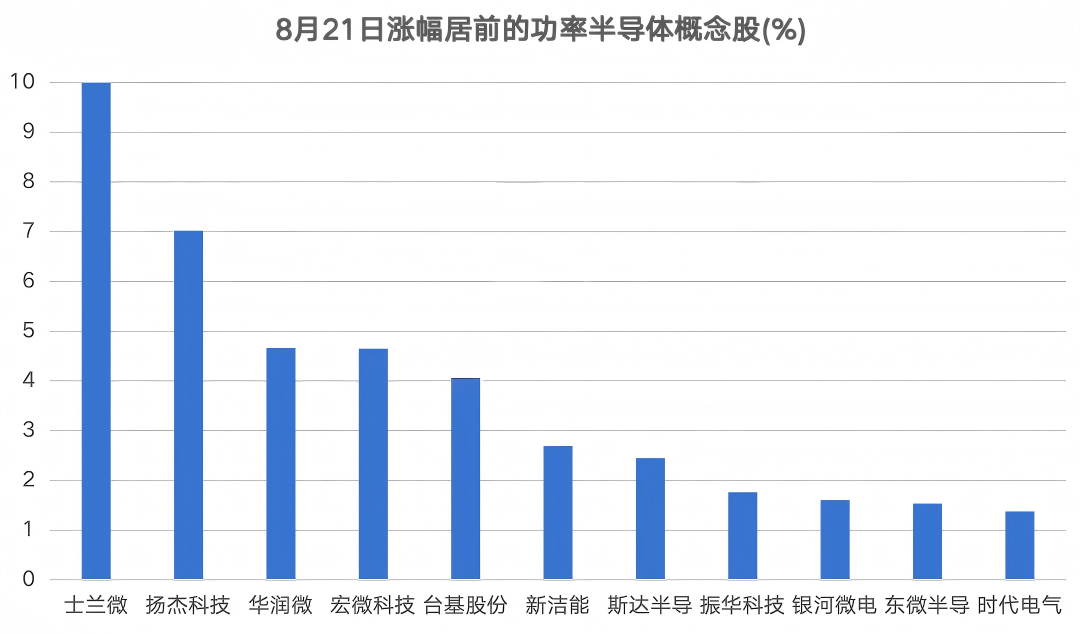
需求及成本双重影响 功率半导体公司再次酝酿价格调整 整体来看,截至8月21日收盘,A股功率半导体概念股平均涨幅接近2%,大幅跑赢上证指数,板块内仅少数个股收跌。

B | 功率半导体板块的爆发或与相关公司涨价有关。 消息面上,受人工智能(AI)服务器、新能源汽车、光储等领域需求爆发,叠加晶圆、封装产能紧张、原材料价格大幅上涨等成本因素影响,多家功率半导体厂商正酝酿新一轮价格调整,涨价幅度预计在10%—15%。 此前,国内多家功率半导体企业已向客户下发价格调整通知。立昂微向客户发布产品价格调整通知函,自2026年6月15日起,公司功率芯片业务全系产品上调10%—15%。 士兰微也发布《价格调整通知函》,宣布自2026年7月1日起对公司产品价格上调15%以上。

C | 另外,扬杰科技表示,受行业大环境影响,近年来上游芯片晶圆、大宗金属、封装原材料全线持续涨价。

D | 步入下半年,原材料再度迎来大幅涨价周期,成本增幅超出预期。为保障产品品质稳定、确保供应链可持续交付,经审慎研究评估,公司决定对全系列产品价格进行调整,调整幅度为10%至15%,新价格自2026年7月1日起出货正式执行。 中国功率半导体市场规模有望稳健增长 功率半导体,又称电力电子器件或功率电子器件,是电子产业链中最核心的器件之一,能够实现电能转换和电路控制,在电路中主要起着功率转换、功率放大、功率开关、线路保护等作用,相当于电力电子系统中的“电子开关”与“能量阀门”。 在业内看来,功率半导体行业正迎来“量价双升、供需缺口持续扩大”的黄金窗口期。

E | 受益于需求的持续增长,全球功率半导体市场展现出强劲增长动能。中商产业研究院发布的《2025—2030年中国功率半导体产业市场研究及发展前景投资预测分析报告》(下称《报告》)显示,全球功率半导体市场规模从2021年的4753亿元增至2025年的约6101亿元,预计到2026年全球功率半导体市场规模将达到约6250亿元。 作为全球最大的功率半导体消费市场,受益于国产替代加速,新能源产业链的完整布局、制造业转型升级的持续推进以及AI数据中心迅速发展等因素,中国功率半导体市场规模保持稳健增长。国际半导体产业咨询机构Yole Group发布的《2026年功率电子产业现状》显示,国产替代进程持续提速。全球功率半导体收入榜单中,五家中国制造商跻身榜单前二十,包括华润微电子、士兰微电子、比亚迪半导体和中国中车等。 上述《报告》还显示,2025年中国功率半导体市场规模约1871亿元,预计2026年将达到约2080亿元,据此测算,2026年中国功率半导体在全球市场份额将超过33%。

F | 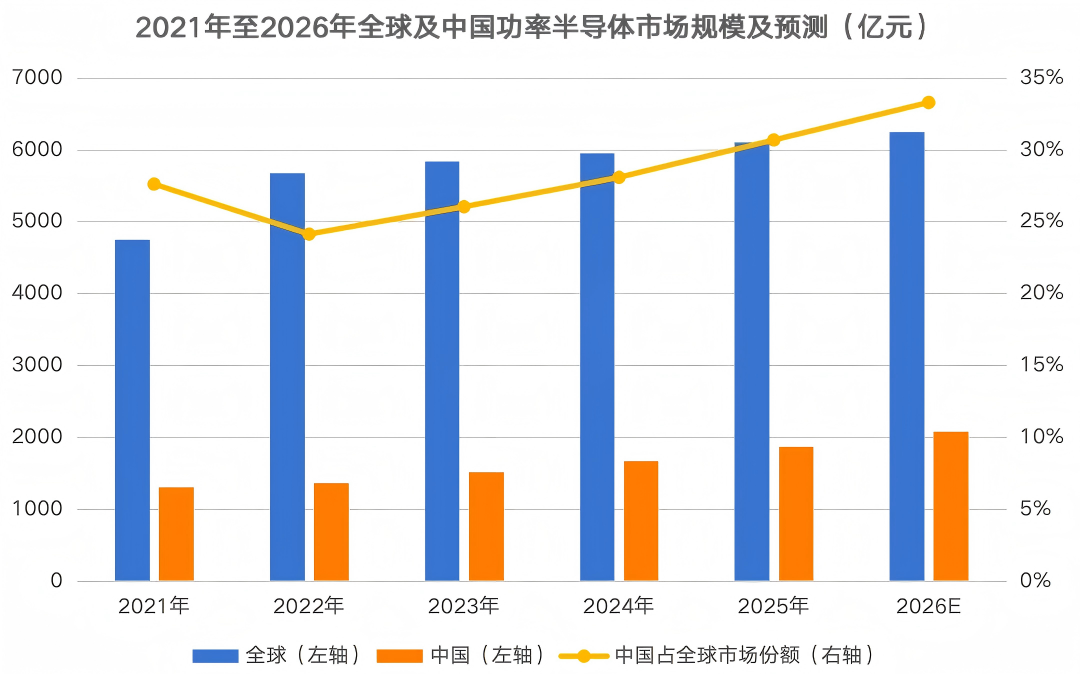 A股功率半导体板块迎来业绩上升期 开源证券表示,经历了前期的动荡时期后,电力电子行业正进入一个以整合、成本优化和竞争定位为重点的新阶段。 从业绩来看,上述21只功率半导体概念股2025年上半年净利润合计近260亿元,同比增长近24%。截至8月21日收盘,14只概念股披露2026年半年报(含业绩预告,取下限)。

G | 整体来看,经历了2024年业绩下滑后,功率半导体公司业绩迎来持续的上升期。14只概念股2026年上半年实现净利润近80亿元,按可比口径计算,上半年净利润同比增长近23%,连续2年上半年保持增长趋势。其中,12只概念股今年上半年均实现盈利,TCL中环今年上半年亏损额收窄,*ST闻泰受子公司境外主体控制权受限影响,今年上半年业绩亏损,但亏损额相较于去年下半年已大幅收窄。 具体来看,6只个股今年上半年净利润超过1亿元,包括时代电气、扬杰科技、士兰微等。 时代电气今年上半年实现净利润17.12亿元,同比增长2.44%,净利润规模创2021年以来同期最高水平。

H | 在IGBT和碳化硅(SiC)领域,公司是国内少数具备650V—6500V产品及工程化能力的企业,拥有服务AI电源、高压直流输电(HVDC)的完整产品型谱。 扬杰科技今年上半年净利润下限超过7亿元,同比增幅下限达到20%。公司自成立以来,始终聚焦在功率半导体赛道深耕发展,目前主营产品主要分为三大板块,包括材料板块、晶圆板块及封装器件板块。 士兰微今年上半年净利润下限超过5亿元,同比增幅下限超过95%。公司是国内功率半导体IDM龙头之一,产品线广度对标英飞凌,沿硅基的IGBT与MOSFET、第三代半导体(SiC与GaN)以及12英寸高端模拟集成电路芯片三条主线并进。 8股获融资客重点埋伏 从融资余额来看,上述21只功率半导体概念股中,有19只属于融资融券标的,其中12只个股年内均获得融资客加仓。截至8月20日,融资余额较去年末增幅超过20%的功率半导体概念股有8只,包括银河微电、富满微、国电南瑞等。 银河微电获融资客加仓超过159%。

I | 公司深耕半导体分立器件,主营各类半导体元器件,包括小信号器件、功率器件等。 富满微获融资客加仓超过93%。

J | 国电南瑞获融资客加仓近57%,公司功率半导体产业聚焦服务新型电力系统建设。 市场方面,上述8股今年以来平均涨幅超过25%,富满微今年以来累计涨幅超过86%,居首。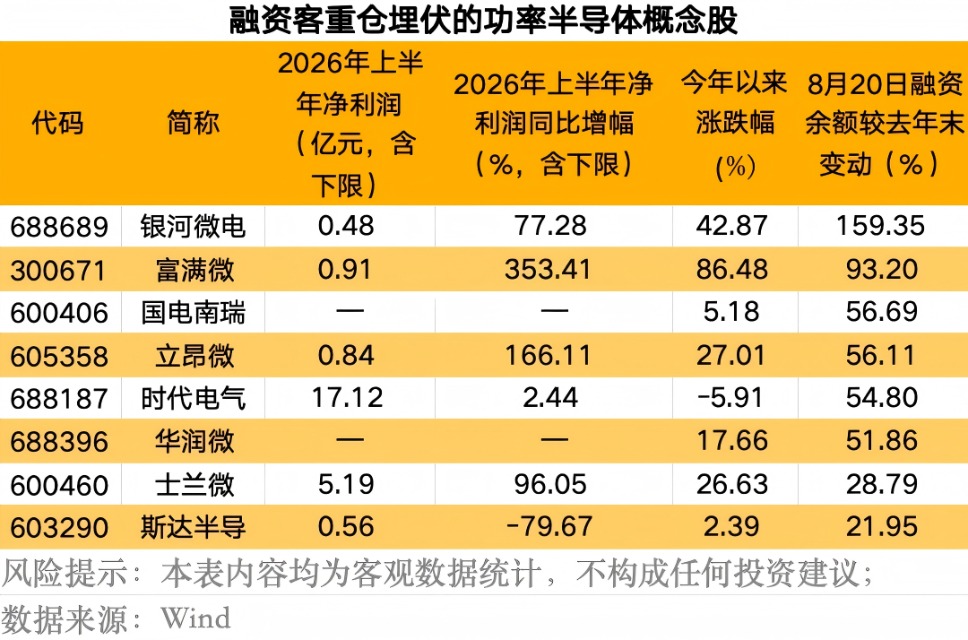 (文章来源:数据宝)。
Current article:http://c2vn.choumaimuwogenkuzhainuan.bond/rbk04d/u7tkky1.html
Published on:15:42:11

